
THE TEAMWORK BEHIND HEALTHCARE UI LOCALIZATION Portada
03/06/2026

The Teamwork Behind Healthcare UI Localization

Localizing healthcare user interfaces is a collaborative process that involves technical skills, structured workflows, and a clear understanding of how users interact with digital platforms. Translators rarely work alone in this effort; behind the scenes, there are also project managers and technical teams supporting the process to ensure nothing disrupts the interface or the patient’s experience.

From preparing complex files to flagging pre-launch layout issues, each team member plays a key role. Here, we explore several key steps that translators and project managers take to ensure productive collaboration throughout the UI localization process.

Step 1: Preparing Files to Avoid Encoding Issues

Before translators even see a file, project managers and technical teams play a critical role in preparing it for smooth processing. In software localization, files like HTML, XML, or exported tables can contain encoding issues like broken tags, strange symbols, or hidden characters that will disrupt the translation process.

To avoid these roadblocks, PMs collaborate with technical specialists to convert and clean the files before assigning them. As Terra’s in-house translator Jorge Zeghen explains, this step makes a big difference. “Good file preparation means I don’t see lines of code or strange characters interfering with the content,” he says. “That allows me to focus entirely on the translation.”

By tackling file conversion and cleaning up front, the team ensures the right content appears inside the CAT tool. This proactive collaboration prevents errors and saves time, as it helps translators deliver accurate results without delays.

Step 2: Flagging Issues Before Translating UI

Given the complexity of the files being handled, minor formatting issues can have a significant impact on the localization process. Catching these problems early on, therefore, is essential, and it’s why translators often adopt a “look before they leap” approach to their work. Before translating a word, they’ll examine the content’s formatting. When something looks off, translators flag the issue for their project manager, who can then bring in the technical team to investigate and correct it.

For instance, if an Excel file is exported without proper line breaks, the content might appear crammed into a single paragraph once it’s imported into the CAT tool. Formatting like that, of course, is much harder to read, translate, and segment correctly. With the right technical support, however, issues like this can be quickly diagnosed and fixed to restore the structure and avoid layout difficulties down the line.

This kind of collaboration keeps the workflow smooth: translators spot issues; PMs coordinate with technical experts to handle the fix, and the content is handed back to the translators. Together, they ensure the content gets clean and stays clean for seamless integration with the CAT Tool.

Step 3: Translating UI Text with Limited Visual Context

Another common challenge in software localization is translating UI content without seeing how it will appear in the interface. Translators often work with strings only, meaning they won’t know the strings’ exact placement or design constraints.

This can be especially tricky with space-limited elements like buttons, where text expansion in other languages becomes a real issue. As Jorge notes, “Having early access to reference materials like screenshots and character limits is key,” and he offers a button translation as an example. “If I’m translating a button in English that says, ‘Access Your Test Results,’ to Spanish, the Spanish version could be ‘Acceda a sus resultados de exámenes’. But I have to make sure this translation will work within the length constraints so it doesn’t break the button’s layout. If it’s too long, I need to come up with a different solution. I might just go with ‘Resultados de exámenes,’ which means relying on the user to make a small leap in understanding that if they click the button, they’ll gain that access, even if I don’t state it explicitly. Knowing I need to pivot like that early on means I don’t have to correct a broken layout later, when time might be tight.”

When project managers proactively provide this kind of context, translators can make better decisions earlier, which helps avoid layout issues, revisions, and delays further in the process.

Step 4: Maintaining Consistency Across Screens

When localizing healthcare software, clarity depends on how consistently content is worded across the entire experience, from the app to the website. Users rely on familiar language to navigate confidently, and if the same action is phrased differently on each screen, it can lead to hesitation or confusion. “Titles, subtitles, and buttons have to appear with the same, equivalent access across pages and sections,” Jorge says. “That way, patients and caregivers always know where to go.”

A seamless navigation experience like this is the result of collaboration. Localization experts rely on translation memories and style guides to stay aligned across platforms, while project managers ensure those tools are up to date across all batches. “Consistency is the goal,” Jorge says, “because when wording is consistent, users feel more confident and are more likely to trust the platform.”

Conclusion

Successful UI localization in healthcare depends on close coordination among linguists, project managers, and technical teams. From file preparation to cross-team communication, every step contributes to building software that is both user-friendly and consistent. When localization teams work in sync, they help deliver reliable experiences that patients and providers can trust, no matter the language or platform.


Pre-Poduction in Audio localization Portada
05/05/2026

Setting the Stage: Pre-Production in Audio Localization

We all know recording often gets the spotlight in audio localization, since the booth is where voices come to life, and the final product begins to take shape. But a smooth session is the result of hard advance work that happens out of the spotlight to keep issues from surfacing once the recording light turns on.

This pre-production phase is where many of those issues are identified, discussed, and, ideally, resolved before they become costly problems. The process may not be identifiable in the final audio, but it plays a defining role in how smoothly a project moves forward. To understand why, it helps to look at what happens before recording begins, and how that preparation shapes everything that follows.

What Pre-Production Really Means in Audio Localization

Pre-production is not a single task or a quick checklist. In fact, it is a coordinated phase in which linguistic, technical, and creative elements are aligned before any recording takes place. At this stage, teams work through a range of tasks and decisions that directly affect both performance and production, including:

Reviewing technical specifications
  • Reviewing technical specifications
  • Validating scripts for recording readiness
  • Preparing glossaries and pronunciation guidance
  • Gathering visual or narrative context
  • Organizing session logistics across teams or languages

Each of these steps reduces uncertainty. When performed well, pre-production will ultimately create a shared understanding among every team member involved in the project, from linguists and directors to actors and engineers. With a universal vision and sense of understanding, recording sessions can focus on performance, rather than unexpected problem-solving.

Where Things Go Wrong Without Pre-Production

When pre-production is rushed or incomplete, the impact is rarely immediate. Issues tend to surface during recording or later, in post-production, when they are harder and more expensive to fix.

A script that has not been prepared carefully, for example, can create a chain reaction. Terminology that hasn’t been clarified in advance may lead to inconsistent pronunciations across audio versions. Insufficient context accompanying the script can lead to performances astray from the intended tone or emotional weight. If timing constraints were not considered early, teams may be forced to make hurried adjustments during the session, which can disrupt rhythm and affect clarity.

  • Poor pre-production often leads to:
  • Re-recordings to correct avoidable errors
  • Interruptions during sessions to clarify basic information
  • Delays caused by back-and-forth between teams
  • Inconsistencies that require additional quality checks later

By the time these issues reach the booth, they are no longer simple adjustments to be made, but true production challenges. And again, many of these complexities could have been identified long before anyone stepped up to the microphone.

Turning Preparation into a Strategic Advantage

Well-structured pre-production changes how the rest of the project unfolds.

Well-structured pre-production changes how the rest of the project unfolds. When expectations are clearly defined, actors can focus on performance with a stronger sense of direction, and directors can guide sessions without needing to revisit basic decisions. Terminology remains consistent across languages because it has already been agreed upon, and scheduling becomes easier to manage when dependencies are identified early.

This level of preparation also supports collaboration. Linguists, audio specialists, and project managers begin their work from a shared understanding, which reduces the need for reactive communication once recording starts. Instead of resolving uncertainties on the spot, teams can concentrate on refining delivery and maintaining quality throughout the process.

The impact of quality pre-production is not always visible as a single moment of improvement, but it becomes clear across the entire workflow. Sessions run more smoothly with targeted revisions, and the path from script to final delivery feels more controlled.

Conclusion

Quality audio localization takes shape long before recording begins. The clarity established during pre-production influences how the entire project unfolds, from performance to post-production and final delivery.

When the pre-production phase is handled with care, the entire process becomes more predictable and the results more consistent. The advanced work itself may remain behind the scenes, but it plays a decisive role in how the final audio is experienced.

Best Practices for Translating Healthcare Materials for LEP Families - Portada
29/04/2026

Best Practices for Translating Healthcare Materials for LEP Families

Families with limited English proficiency (LEP) often face persistent challenges in understanding and accessing healthcare. While live interpretation services are important, properly translated written materials also offer unique benefits: they are a resource that families can read at their own pace, revisit at any time, share with others, and use to feel confident about following the right care instruction steps at home.

When these documents are clear, culturally respectful, linguistically accurate, and tailored to the reader’s context, they become an extension of patient-centered care. In this article, we’ll share practical advice when translating materials to meet the needs of LEP families.

1. Adapt Tone and Reading Level to Fit the Family’s Needs 

Just because a document is translated into a target language doesn’t mean it’s fully understandable or appropriate for every audience. The translation process requires a careful balance of tone, cultural sensitivity, and a sense of formality. When translating into Spanish, for instance, materials addressed to adult caregivers should have a formal tone (usted) to convey respect. If the content clearly aims at youngsters, on the other hand, a more informal tone () might feel more natural to those readers depending on their cultural background. These choices should never be made at random but should be informed by the norms and expectations of the intended reader.

Another key consideration is readability. Translating at a 4th–6th grade reading level ensures that both caregivers and, when appropriate, children can understand the material. This doesn’t mean simplifying content to the point of sacrificing meaning or essential information, but rather, it helps ensure that vital instructions are made clear, especially in stressful or unfamiliar situations. When families feel that healthcare materials are speaking directly and respectfully to them, comprehension increases, and so does trust.

2. Make the Content Visually Clear and Easy to Follow 

Effective healthcare translation considers how information is presented. Families that are under stress or unfamiliar with medical terms tend to benefit from visual clarity and thoughtful design that reinforces meaning.

Visual aids such as icons, diagrams, and illustrations can be extremely helpful in supporting key instructions. For instance, a simple chart or carefully translated image can help explain how to take a medication or prepare for a test. Color-coded sections can signal timing, dosage, or urgency more clearly.

For materials intended for bilingual households or children, offering side-by-side translations (e.g., English and Spanish) allows caregivers to cross-reference and feel more confident in their understanding. 

3. Respect Formatting, Identity, and Cultural Preferences 

Thoughtful formatting and small linguistic details can make a big difference. These choices not only improve clarity but also show respect for the reader’s identity and cultural context. The following practices help ensure translated materials are accurate, inclusive, and easy to follow:

  • Names: Always preserve accents and other diacritical marks in proper names. This demonstrates respect for identity and attention to detail. For example, a German name like Jürgen Müller should never be simplified to Jurgen Muller. 
  • Gender Sensitivity: When gender is unknown, it’s best to use inclusive phrasing that avoids binary forms. For example, in Spanish, instead of using enfermero(a) (“nurse”) to include all genders, a more neutral and inclusive option would be personal de enfermería (“nursing staff”). Many languages offer similar solutions, such as using plural or collective nouns to create welcoming, gender-neutral language for all families. 
  • Dates: Date formats vary widely. In the U.S., the standard is month/day/year, while most other countries use day/month/year. To avoid confusion and when space allows, it’s best to spell out the full date in the target language of the translation. For example, in Italian: 8 luglio 2025
  • Numbers: Decimal separators also differ across languages and regions. While some countries prefer commas (e.g., 2,5), others use periods (e.g., 2.5). Always adapt to the conventions of the target audience to avoid misinterpretation, especially in dosage instructions, lab results, or time-sensitive data.
  • Time References: When times are written in the 12-hour format, it’s easy to understand when the abbreviations “a. m.” and “p. m.” are added. In some cases, it can help to reinforce meaning by adding explanatory language, such as “9:00 in the morning” or “9:00 at night”.
  • Department & Division Names: Department names or their abbreviations must be translated on first mention, with the English in parentheses. For example, in a French translation: Département de pédiatrie (Department of Pediatrics).
  • Medication Names: On first mention of a medication, names should be translated and then followed by the English name in parentheses. For example, in a German translation: Hydrocortison (hydrocortisone). This practice makes it easier to remember the medication name, especially when buying it.
  • Resources: When additional resource content is included in the format of QR codes, links, or URLs, it’s useful, whenever possible, to add the officially translated version into the target language. Otherwise, provide the English link with a translated label in parentheses.

Conclusion

Accurate and accessible translation of written healthcare materials empowers families with limited English proficiency by supporting better decision-making, reducing confusion, and affirming dignity in care.

When hospitals and healthcare organizations work with language partners to prioritize tone, reading level, formatting, and cultural accuracy in their written content, they’re not only meeting compliance, but also meeting their patient families where they are. In so doing, providers build lasting trust and truly inclusive care environments.

The-First-Line-of-Quality-Reviewers-and-Proofreaders-in-Modern-Localization-Portada
24/03/2026

The First Line of Quality: Reviewers and Proofreaders in Modern Localization

Quality assurance in localization is often associated with final checks, delivery gates, or last-minute validations. In reality, some of the most impactful quality decisions are made much earlier in the process. Many of those decisions are influenced by reviewers and proofreaders who play a crucial role in shaping how content reads, feels, and communicates before it moves further down the pipeline.

Their work creates a linguistic baseline that influences every element of localization that follows. By addressing clarity, tone, and consistency up front, these experts help prevent errors from spreading across files, languages, or iterations. In fast-moving localization environments, this early layer of quality assurance becomes a stabilizing force.

Building Quality Before It Scales 

The work of reviewers and proofreaders involves more than catching typos. It also includes verifying consistent terminology; ensuring the tone of the project resonates with the audience; and guaranteeing that localized content reads naturally. The decisions that reviewers and proofreaders make bear extra weight because they’re often carried forward as projects grow.

When content is reused, expanded, or adapted into multiple formats, early linguistic choices can either support consistency or introduce dissonance. That’s why catching misaligned terminology or awkward phrasing early on reduces the need for corrections later, when changes are more disruptive and costly.

In this sense, these linguists act as quality anchors. They help ensure that whatever content moves forward is solid enough to withstand and support growth, updates, and multilingual expansion without constant rework.

Working with Technology, Not Against It 

Technology has changed how reviewing and proofreading are carried out. Many linguists, for example, engage automated tools to flag repeated errors, inconsistencies, or formatting issues quickly and reliably. Automated support like this improves visibility and reduces the time linguists would otherwise spend on mechanical checks.

What technology cannot do, however, is effectively evaluate meaning, intent, or audience expectations. Reviewers still rely on experience and context to determine whether a sentence sounds appropriate, whether a set of instructions are clear, or whether a piece’s tone fits its purpose.

By engaging meaningfully with automation, reviewers can focus their attention where it adds the most value. The result is a workflow that is both more efficient and more thoughtful.

Collaboration as a Quality Multiplier 

Reviewers and proofreaders are part of a broader ecosystem of quality assurance. The efficacy of their work depends on clear communication with translators, project managers, and quality leads. When their feedback is timely, specific, and consistent, teams can learn from previous iterations and align more quickly.

Over time, collaboration like this reduces recurring issues and strengthens shared standards. It’s how review and proofreading become not only corrective steps, but also a proactive process towards long-term quality improvement across projects and teams. 

Conclusion 

Reviewers and proofreaders form the first structured layer of quality assurance in modern localization workflows. Their work helps to ensure content is clear, consistent, and ready to scale before it reaches later stages of production.

In a technology-enabled environment where speed and volume are only increasing, early human oversight remains essential. By combining professional judgment with tool-supported insights, reviewers and proofreaders help build quality thoughtfully and deliberately as they set the stage for reliable and trusted localized content.

The-Teams-and-Systems-Behind-Modern-Localization-QA-Portada
10/02/2026

The Teams and Systems Behind Modern LQA

The quality assurance (QA) component of the localization process is often perceived as a final checkpoint: the moment when near-complete content is reviewed right before delivery. In reality, however, for LQA to be truly effective, collaborative review protocols need to be implemented early on and sustained throughout the lifecycle of a project. Actual quality emerges from the combined contributions of people, workflows, and systems, which all must evolve alongside changing technology and increasing content demands to produce a top-quality result.

As automation and AI-assisted tools become part of everyday localization pipelines, quality assurance, too, is being delivered in ever-expanding ways. That’s not because QA technology can replace human expertise, but rather, because it can help to reshape how quality is managed, monitored, and maintained at scale. In this context, QA functions as a service that connects disciplines, and not just a last-minute, isolated task that’s performed at a project’s conclusion.

Quality as a Continuous Service 

Modern localization projects rarely follow a predictable, linear path. Challenges can include content updates arriving late; languages being added midstream, and delivery schedules tightening. In this environment, the quality of the localization can’t be determined by isolated checks or a sole manual effort.

Instead, QA can be carried out successfully by operating as a continuous service that accompanies content across stages and iterations. Automated checks help surface problematic patterns, enforce baseline consistency, and reduce repetitive tasks. Human expertise, meanwhile, focuses on interpretation, clarity, and contextual accuracy. Together, they form a framework that supports both speed and reliability.

This paired approach allows teams to respond to changes in a project’s scope or timeline while maintaining coherence across languages and platforms.

Quality Management as a Shared Responsibility 

Quality assurance is sustained through the collaboration of multiple roles that each contributes to a different perspective.

  • Reviewers and proofreaders often act as the first structured point of QA contact, as they ensure that content reads naturally, communicates clearly, and aligns with its intended audience. Their work helps stabilize much of a project’s content quality early on, before issues travel downstream. 
  • Multilingual Quality Assurance Managers (QAMs) take a broader view. People in these roles oversee how quality standards are applied across languages, track recurring patterns, and translate feedback into process improvements. QAMs bridge linguistic expertise, operational needs, and tool-supported insights.

Together, these roles form a quality management layer that balances detail-oriented reviews with strategic oversight. Automation, meanwhile, supports this work by providing visibility and structure, but decisions remain grounded in professional human judgment and experience.

Alignment Across Roles and Workflows 

Quality thrives on coordination. Reviewers, proofreaders, QAMs, and project managers, as well as technical and operational teams, all contribute to the caliber of a project’s outcome. Along the way, clear workflows, shared standards, and consistent communication allow quality to remain stable even as projects may increase in scope and complexity.

Technology plays a supporting role in these scenarios. Centralized platforms, reporting tools, and automated checks reduce friction and help teams stay aligned while they collaborate to resolve ambiguities, adapt guidelines, and respond to real-world constraints.

When alignment is strong, quality reviewing becomes predictable and sustainable rather than reactive. 

Technology as an Enabler of Scalable Quality 

Automation has become a helpful part of modern QA workflows. Tasks such as terminology validation, formatting checks, and consistency scans can now be performed faster and more reliably through automated systems, and these tools also introduce stronger structure and traceability features, especially when applied to large-scale projects.

The value of automation lies in what it enables. By handling repetitive or mechanical checks, automation frees teams to focus on QA at a distinctly human level, including the evaluation of content for its meaning, tone, and user experience. In other words, automation supports prioritization and transparency without removing human accountability.

When employed thoughtfully, technology strengthens quality assurance by making it more manageable and resilient in fast-moving environments.

Why Quality Matters More in a Tech-Driven Era 

As localization workflows accelerate, quality assurance acts as a stabilizing force. It ensures that efficiency does not compromise clarity, client and user trust, or usability. In a world where localized content reaches global audiences instantly, delivering consistency and reliability carries long-term value.

Quality assurance is less about perfection than confidence: that content is communicating what it should, in the way it should, across languages and contexts.

Conclusion 

Modern localization QA is a collective effort shaped by people, processes, and technology. Reviewers, proofreaders, and QAMs contribute different layers of oversight, while automated tools support scale and consistency. Together, they form a quality assurance ecosystem that adapts to change while maintaining its direction.

When viewed through this lens, quality assurance becomes a strategic service throughout the life of a project, rather than a final safeguard. It’s a service that supports growth, reinforces trust, and ensures that localization delivers meaningful results in an increasingly technology-enabled world.

How Localization Consultancy Elevates Game Development Across All Genres - Portada
22/01/2026

How Localization Consultancy Elevates Game Development

Every game, whether it’s a small mobile puzzle or a massive AAA release, faces the same demand: its players expect an entertainment experience that feels natural in their own language and culture. While the requirements to meet this challenge differ depending on a game’s scope, narrative depth, or mechanics, the need for expert guidance in this realm of development is constant.

Localization consultancy meets this need by helping studios navigate cultural nuances, technical complexities, and shifting player expectations. Rather than focusing on a single type of game, consultants provide strategies that are adaptive to any genre, thus ensuring that every title has what it takes to succeed with players on a global stage.

Key Challenges Consultants Address Across Genres 

Every gaming genre has its unique traits, but many of the localization challenges they present are universal. Consultants know these challenges well, and these are the areas where they bring clarity and expertise to the development process, regardless of the game type that’s being produced:

  • Adapting Narrative and Cultural Content: Storytelling is central to many games, but jokes, idioms, and cultural references rarely translate directly. Consultants advise on how to adapt this content without sacrificing a game’s intent by making sure that humor lands, metaphors resonate, and dialogue feels authentic across regions. 
  • Technical Adaptation: Every game relies on text, menus, and interfaces. Consultants help identify potential pitfalls in UI layouts, code integration, and in-game text management. Their technical perspective prevents errors such as text overflow, broken formatting, or untranslated strings slipping into the final build. 
  • Consistency Beyond Gameplay: The game itself is only part of the player experience. Marketing campaigns, tutorials, and instructional materials all need to align with the localized product. Consultants ensure consistency across these touchpoints, so players enjoy unified, professional encounters from the very first trailer to post-launch support. 

Consultancy Strategies for Broad Impact 

Strong consultancy includes adaptability. Consultants can tailor workflows to fit the scope of any game, from short development cycles to multi-year productions. While scaling these workflows, consultants are balancing efficiency with quality, integrating cultural insights at every stage, and aligning strategies with global trends in player behavior.

Another core element of consultancy work is risk mitigation. By reviewing content prior to launch, consultants help studios avoid cultural missteps that could harm player reception or trigger regulatory concerns. This foresight reduces the chance of costly backlash—in terms of both reputation and post-release corrections requiring time and expense—and safeguards the standing of the studio across international markets.

Perhaps most importantly, consultancy encourages teams to view localization as part of the creative process rather than a post-production step. With cultural and linguistic expertise embedded into their production workflow, games ultimately feel more inclusive to a global player base. And that player base is likelier to want a long-lasting relationship with these resonant gaming experiences.

Conclusion 

No matter a game’s genre, that act of incorporating localization consultancy into its production elevates its development by combining cultural awareness, technical preparation, and strategic insight. Localization ensures that every title, from indie experiments to blockbuster franchises, is ready to engage players across regions with authenticity and clarity.

For developers looking to reach global audiences, consultancy is not a genre-specific advantage, but a universal necessity for creating games that resonate everywhere.

Making Edutainment Work Technology, Global Reach, and Cultural Adaptation - Portada
13/01/2026

Making Edutainment Work for Global Audiences

Edutainment has proven its value by effectively blending learning with play, but rendering these tools successful on a global scale requires developmental creativity on many levels. Producing resources that are genuinely entertaining and instructive for a worldwide audience requires the right technology, proper cultural adaptation, and strong accessibility measures to ensure learners everywhere can connect with the content. That’s why, from virtual reality simulations to multilingual storytelling, the key to quality is building edutainment solutions that are both innovative and inclusive.

The Role of Technology in Edutainment 

Advancements in digital tools are reshaping how people learn. Technology-driven platforms, for example, can personalize content in a way that adapts the pace or style of instruction to an individual’s needs. Virtual and augmented reality can place learners inside unforgettable immersive environments, whether they’re exploring ancient civilizations or simulating complex medical procedures. Gamification, through rewards, challenges, and progress tracking, leans on motivation to keep learners engaged over time.

Equally important to learners are an edutainment product’s accessibility features. Effective interfaces tend to be highly intuitive, with options that may include captions, adjustable text, or alternative input methods. This is the sort of technology that supports diverse learners by enhancing both engagement and equity in education. 

Global Reach and Localization 

Technology provides the platform for edutainment, but content localization ensures a product can resonate worldwide. Simply translating text for learners is not enough; truly effective edutainment considers multilingual content, offers regionalized examples, and engages in culturally appropriate storytelling that reflects the values and contexts of different audiences.

For instance, an app designed for science education might feature case studies relevant to a particular region of users, while a language-learning game may adapt humor and idioms to align with local usage. These adjustments make edutainment content feel familiar and trustworthy to users, and encourages them to connect more deeply.

Challenges in Scaling Edutainment Globally 

Expanding edutainment across borders can present both technical and cultural hurdles for developers. Balancing educational value with entertainment is already a challenge, but adding global considerations to the mix raises the stakes. Some of the most common challenges include:

  • Technical Adaptation: Software must support different scripts, fonts, and formatting conventions, while also being compatible with regional devices and platforms.
  • Cultural Resonance: Features like voiceovers, visuals, or humor may work in one region but feel confusing or even inappropriate in another.
  • Balance Between Specificity and Universality: Content that ends up being localized too generically risks losing its authenticity with viewers. At the same time, content that’s tied too closely to one culture may alienate global learners.

Striking the right balance in these areas ensures that a product will maintain both its educational integrity and its universal appeal.

The Future of Edutainment 

Looking ahead, the possibilities for edutainment continue to grow. Cross-platform experiences will allow learners to move seamlessly between devices, whether at home, school, or on the go. AI-assisted content creation will provide adaptive learning paths that adjust in real time. Fully immersive environments will give learners the chance to practice skills in safe, simulated spaces.

For these innovations to succeed, inclusivity and multilingual support must remain at the center of edutainment developers’ focus. Accessibility features, cultural awareness, and thoughtful localization will determine whether edutainment can reach learners equitably, regardless of their cultural background or region of the world. 

Conclusion 

Edutainment thrives when it combines ever-advancing technology with cultural and linguistic adaptation. By investing in accessible design and global localization, creators can build tools that are not only engaging for all users, but also truly inclusive. Such a balance ensures that edutainment fulfills its promise of making learning meaningful and enjoyable for learners everywhere.

As this series continues, we will take a closer look at how services such as localization, voiceover, and culturalization bring edutainment to life on a global scale.

Internationalization-i18n-The-Hidden-Framework-of-Game-Localization-Portada
22/12/2025

Internationalization (i18n): The Hidden Framework of Game Localization

Successful video game localization includes a critical developmental stage that lays the groundwork for everything that follows. While localization (l10n) does the work of adapting a game to specific languages and cultures, internationalization, often shortened to i18n, prepares the technical foundation that makes those adaptations possible. Internationalization is an invisible framework that ensures games can scale globally without constant rework or costly fixes. 

For studios aiming to release in multiple regions, strong i18n practices are not optional. They’re the key to making the difference between a game that expands seamlessly into new markets, and a game that stumbles over technical limitations once localization begins. 

Core Tasks of Internationalization 

Internationalization is a broad process, but its core tasks share a common purpose: making games flexible and adaptable for diverse players. These tasks include: 

  • UI/UX Adaptation ensures that interfaces are able to handle more than the original language. Text in one language can expand when it’s translated, and some languages, such as Arabic or Hebrew, require right-to-left support. A flexible UI takes these considerations into account, thus avoiding the need to redesign menus or dialogue boxes later. 
  • Text Separation from Code: Text that is hard-coded into a game’s code becomes a serious headache for developers looking to scale down the line. But separating content from code early on allows translators, now or in the future, to work directly on text without the risk of breaking functionality. It also speeds up localization workflows and reduces bugs. 
  • Unicode and Encoding Support: Games are played in every script, from Latin alphabets to Cyrillic to kanji. Unicode and robust encoding support, therefore, ensure that all characters display correctly, thus avoiding issues such as missing glyphs, corrupted text, or placeholder boxes. 
  • Date, Time, and Number Formatting: Regional differences in how dates, times, and numbers are written may seem like minor details, but they affect player immersion when they’re displayed in an unfamiliar way. Adapting these formats demonstrates a developer’s attention to detail and builds player trust, whether they’re gaming in Tokyo, Paris, or São Paulo. 

Impact of Proper i18n 

When performed correctly, internationalization pays off throughout the development process and beyond. i18n reduces the time and cost of localization by minimizing errors and preventing the need for rework. It also enhances a developer’s confidence that their game can expand into new regions with minimal disruption: that releases across cultures languages will feel seamless and consistent to their players. 

For players, the impact is equally important. Proper i18n creates smoother, more inclusive experiences that are free from distracting glitches and awkward formatting. By laying this groundwork, studios not only simplify the overall localization process but also strengthen their ability to deliver immersive, culturally relevant games on a global scale. 

Conclusion 

Internationalization may be carried out quietly in the background, but it is the backbone of global game readiness. By building flexibility into systems, interfaces, and content structures from the start, developers set themselves up for efficient localization and stronger connections with players worldwide. For studios that include global reach as part of their strategy, investing in i18n is the first step toward success. 

Why Software Localization Matters in Healthcare - portada
09/12/2025

Why Software Localization Matters in Healthcare

As medical services become increasingly digitized, patients and providers are coming to rely on software to book appointments, access medical records, and even receive care through mobile health apps. But when these tools aren’t adapted to the languages and cultural needs of their users, they can create confusion for the patient and provider community, and even present risks. 

In the healthcare industry, the act of localization means tailoring technology so it functions safely, legally, and intuitively for every audience. When done well, localization builds patient trust, reduces errors, and helps ensure that care is accessible to everyone, regardless of what language they speak. 

What Is Software Localization in Healthcare? 

Software localization is the process of adapting digital tools for a specific language, culture, or legal context. Localization teams ensure that apps, platforms, and systems are not only translated, but that the translations are accurate, compliant, and user-friendly. 

This process can involve adjusting the following to align with cultural norms: 

  • On-screen text and system messages 
  • Date, time, and measurement formats 
  • User instructions and error messages 

Healthcare Software That Benefits from Localization 

Healthcare software takes many forms, and each serves a unique purpose in a patient’s journey toward improved wellness. From diagnosis to follow-up care, these tools must work clearly and safely in every language. Here are some of the most common examples in which such software localization plays a critical role: 

  • Electronic Health Records (EHR) and Electronic Medical Record (EMR) platforms 
    Accurate localization ensures that medical staff can enter and access critical data without confusion or error. 
  • Telehealth and virtual care tools 
    Clear communication is essential to successful remote medical consultations. Localized interfaces help patients and providers understand one another, regardless of language. 
  • Medical device software 
    Devices with screens or apps must display information that’s not only technically accurate, but also culturally and linguistically accessible. 
  • Clinical trial and eConsent platforms 
    Informed consent depends on clarity, and that clarity must extend across multiple fronts. Translations have to meet legal standards while still being easy for participants to understand. 
  • Patient portals and mobile health apps 
    Many patients manage appointments, medications, and health records through apps. When these tools are localized, they help reduce misunderstandings and empower users. 

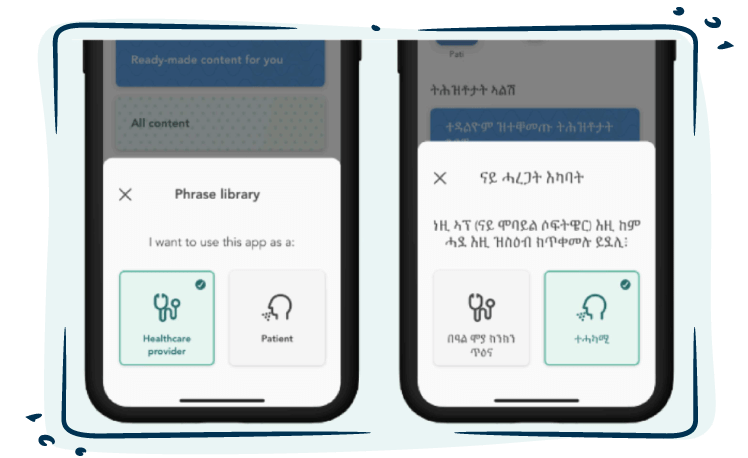
The image below, for instance, shows a mobile app offering a phrase library, with options tailored to either healthcare providers or patients. The interface is fully localized, allowing users to interact in their own language and select the role that best fits their needs. This simple yet critical feature helps create a trustworthy experience, especially for users with limited English proficiency

Two smartphone screens displaying a healthcare app interface. The left screen shows options in English for “Healthcare provider” and “Patient,” while the right screen shows the same options localized into another language, illustrating software localization in healthcare.
Image from Caretotranslate

The Risk of Foregoing Localization

Photo of Ximena Trejo, a Project Manager at Terra.

In some industries, poor localization may be overlooked, but when medical software isn’t properly localized, users may misread instructions, input data incorrectly, or miss critical information. These issues can delay treatment, result in medical record errors, or compromise patient safety.  

Strong localization helps prevent these risks by ensuring that health information is not only linguistically accurate but also aligned with patients’ cultural expectations. As Ximena Trejo, project manager at Terra, explains,“Patients have the right to receive clear and effective communication. It’s reassuring for families to know that even if they don’t speak English, they can access software that’s translated into their own language.” When technology puts patients at the center, it becomes a more reliable tool for delivering equal care. 

Conclusion 

When software reflects the language, culture, and expectations of its users, it helps people receive better care, reduces risks, and strengthens the connection between providers and patients. A thoughtful localization process supports those outcomes by helping healthcare teams deliver clear, consistent, and trusted experiences across every language and touchpoint. 

Culturalization in Pediatric Care Adapting Healthcare Communication for Diverse Needs - Portada
18/11/2025

Culturalization in Pediatric Care: Adapting Healthcare Communication for Diverse Needs

Pediatric patients are often considered an especially vulnerable population because of their developing systems, limited autonomy, and reliance on adults for care. When these patients, or their caregivers, face cultural barriers stemming from their language, religion, cultural norms or trust in medical systems, this vulnerability is heightened. To care for these doubly vulnerable children, who account for a significant portion of US pediatric patients, providers need to not only develop cultural competency but also adapt their healthcare materials to align with the language needs and backgrounds of diverse families.  

Attention to both language and culture when designing healthcare resources plays a role in reducing patient and family anxiety and increasing trust in the provider; it can also improve children’s pediatric care experiences and outcomes. 

Culturalization in Pediatric Healthcare 

Culturalization is a deeper and more comprehensive approach to translation used with medical content to ensure it is not only linguistically accurate but also aligned with the values, beliefs, and expectations of the target audience. Adapting tone, terminology, and cultural references is essential to making information more relatable and engaging.  

A brochure on childhood immunizations might, for example, be translated into Spanish using the formal mode of address and accessible terminology; be adapted to include photos of Hispanic children and families; and include a section addressing vaccine hesitancy and providing questions families can use to start a conversation with their provider.  

The degree to which healthcare materials take patient identities into account influences the way children and parents interact with them, so great attention should be given to tailoring them, especially when they provide key information like treatment options, patient instructions, and health education on a specific topic. 

How Sensitive Translation Improves Patient Engagement 

Sensitive translation is at the root of culturalization and is essential in fostering patient engagement. Tailoring language and content to local values while maintaining accuracy is of the utmost importance because failure to do so can alienate patients or lead to misunderstandings. Below are some examples of healthcare materials that need to be culturally adapted for diverse audiences to increase understanding and compliance: 

  • eConsent forms: Adapt legal tone, reading level, and decision-making language. Consider how family roles and perceptions of medical authority vary across cultures (e.g., collectivist vs. individualist decision-making). 
  • Appointment reminders: Adjust phrasing for formality/informality, preferred time formats (12h vs. 24h), date formats, and cultural holidays or taboos around certain days/times. 

The Role of Culturalization in Reducing Anxiety and Building Trust 

Recognizing that children’s experiences when they receive medical care can significantly impact their overall well-being, healthcare providers have sought to create more positive and empowering encounters through the CARE model, which stands for Choices, Agenda, Resilience and Emotional support. Culturalization contributes to emotionally safe pediatric care by making this model accessible to all patients. Below is a description of each element of the CARE model and how culturalization supports it. 

  • CHOICE: Giving patients a sense of control and agency, even in small ways, can significantly reduce their feelings of powerlessness. Providers might, for example, let the child choose which arm they want a shot in or which comfort measures they want to use. Another way they can support choice is by providing culturally adapted consent forms, instructional materials and educational resources to help families make informed decisions in their preferred language. 
  • AGENDA: Clearly laying out the care plan, including what to expect and what is expected of the patient and family, can alleviate anxiety and promote understanding. Care plans translated using culturally resonant language can help families understand and follow treatment steps confidently. 
  • RESILIENCE: Focusing on a child’s strengths and reframing negative experiences can help build resilience and foster a more positive outlook. Adapting the tone and content of encouraging messages to a specific cultural context can encourage emotional strength in children facing medical stress. 

In short, working in tandem with the CARE model, culturalization fosters trust and reduces anxiety by aligning communication with cultural expectations. 

Conclusion 

Cultural competency in pediatric care is essential to serving children well. While many things contribute to a culturally competent experience, language access and thoughtful translation are integral to ensuring equity and engagement. By integrating language and cultural adaptation into their practice, health care providers can enhance patient experiences, improve outcomes, and build trust with diverse communities.