
Innovation-with-Purpose-Three-Pillars-to-Guide-How-to-Innovate-Portada
11/03/2026

Innovation with Purpose: Three Pillars to Guide How to Innovate

Image of Belén Agulló García, Executive Consultant of Innovation of Terra.

Innovation is often accompanied by noise. New tools, new acronyms, and new, bold promises for efficiency appear almost daily, especially when it comes to AI and automation. For many teams, the challenge is not a lack of ideas; it’s the decision on where to focus without losing sight of people, quality, and long-term impact.

At Terra, innovation is approached through a simple framework inspired by executive consultant of innovation Belén Agulló García’s “Innovation with Purpose” vision. It rests on three pillars that allow us to turn curiosity into meaningful change, without chasing technology for its own sake. 

Pillar 1: Start with the “Why” Before Choosing Any Tool 

One of the most common traps in innovation is beginning with a solution instead of a problem. Teams hear about a platform, a model, or a workflow that worked elsewhere, and they rush to replicate it. Often, their haste results in scattered pilots, muddy outcomes, and human fatigue rather than progress.

A purpose-driven approach, on the other hand, begins with key questions including:

  • What issue are we trying to solve?
  • Who will benefit from this change?
  • How will it improve quality, access, or collaboration?

These questions apply across sectors: healthcare teams may aim to reduce turnaround time for patient-facing information; gaming companies might focus on improving the consistency of player support materials; and education initiatives often seek to make learning content easier to access across languages. When the purpose is clear, technology becomes a means, instead of the driver

Pillar 2: Put People at the Center of Every Innovation 

At Terra, we approach innovation for clients in a way that considers everyone involved in the process. Linguists, reviewers, project managers, engineers, and the communities who interact with the final content all shape what success looks like.

This perspective changes innovation decisions in subtle but important ways. A workflow that saves time but increases the cognitive load for linguists, for example, may not be an improvement. Similarly, a tool that looks powerful but in effect complicates collaboration for clients may slow projects down rather than speed them up.

As Belén often emphasizes, “Innovation should respect the work people already do well.” Building on that idea, linguists can be seen as guardians of language who bring expertise to the table that technology alone cannot replace. When innovation supports linguists’ work instead of sidelining it, quality and trust in the innovation process tend to follow. 

Pillar 3: Measure the Impact, Not Just the Effort 

Trying something new always involves effort, but effort alone is not a measure of success. Innovation with purpose requires defining what success means before a tool or workflow is rolled out.

Depending on the context, impact might be reflected in improved quality, fewer errors, faster turnaround times, better client satisfaction, stronger team well-being, or wider access to information. Without these indicators, it becomes hard to tell whether an initiative should be scaled, adjusted, or paused.

This pillar also helps teams resist adopting technology simply because it is fashionable. Clear metrics create space for learning, not just deployment, and allow innovation to evolve rather than accumulate.

How the Three Pillars Work Together in Practice 

In real projects, these pillars are closely connected. An initiative typically begins by clarifying the “why”. Teams then involve the right people to understand needs and constraints. Then, a solution is selected and piloted with intention, not urgency. Finally, results are reviewed against predefined indicators.

This approach works across industries, since the sequence remains the same whether the context is gaming, healthcare, education, or the public sector. Purpose guides decisions, people shape implementation, and impact determines what comes next.

Conclusion 

The three pillars to purposeful innovation are simple by design: start with why, put people at the center, and measure impact. Together, they offer a practical way to navigate innovation without losing focus on what matters. Whether evaluating AI, exploring new collaboration tools, or rethinking internal processes, this lens can help teams move forward into new territory with confidence.

Innovation-Consultancy-Turning-Ideas-into-Meaningful-Change-Portada
17/02/2026

Innovation Consultancy: Turning Ideas into Meaningful Change 

“Innovation” is often treated as a buzzword; one that’s associated with big ideas, fast growth, or disruptive technology. In practice, though, innovation is a quiet process that’s carried out with great deliberation. It lives in everyday decisions; in how teams solve problems; in how we test new approaches and adapt to constant change. And it’s in this quieter space of brainstorming and adaptation where innovation consultancy can support organizations in turning ideas into action.

Innovation consultancy helps teams question existing processes, explore alternatives, and design solutions that are both creative and practical. Rather than offering ready-made answers, innovation consultants work alongside teams to guide thinking, structure experimentation, and ensure that work is intentional, and progress is sustainable.

What Innovation Consultants Do, Day by Day 

Innovation consultants work at the intersection of strategy, creativity, and execution. Their role goes far beyond brainstorming sessions or future-facing concepts; in fact, much of their work is grounded in everyday operations, where incremental changes can have a lasting impact.

This often means they’re analyzing workflows, identifying friction points, and helping teams decide what is truly worth changing. Innovation consultancy also involves facilitating collaboration across departments, aligning technology with human needs, and creating space for experimentation without unnecessary risk. Rather than pushing ideas forward too quickly, consultants help teams test, refine, and learn from these efforts before making any broad-scale changes.

In fast-changing environments, innovation consultants act as steady reference points. They support teams by navigating uncertainty, managing competing priorities, and maintaining clarity when timelines or expectations tighten. By encouraging reflection and continuous learning, they help organizations build innovation into how work gets done, rather than treating it as a separate initiative. 

Terra’s Executive Consultant of Innovation: Belén Agulló García 

Image of Belén Agulló García, Executive Consultant of Innovation of Terra.

At Terra, innovation consultancy takes shape under the direction of Belén Agulló García, executive consultant of innovation. Her role requires expertise in several areas including strategy, language, and real operational practice as her teams turn ideas into concrete, workable initiatives that hold up in day-to-day contexts.

Belén brings a strong academic foundation to her work. She holds a degree in Translation and Interpreting, a master’s degree in Audiovisual Translation, and a PhD in Translation and Intercultural Studies. Her broad academic background informs her understanding of how language, technology, and culture intersect—and interact—particularly in complex, multilingual environments.

On her professional path, Belén has spent more than fifteen years in the video game localization industry in roles such as project manager, translation director, and quality and innovation lead. This hands-on experience allows her to approach innovation from within existing workflows, with a clear view of any constraints, risks, and opportunities for meaningful change that may be at play.

In practical terms, her work includes:

  • Assessing processes and workflows to identify where change can add real value
  • Supporting teams as they explore new approaches, tools, or ways of working
  • Helping align innovation initiatives with business goals and human needs
  • Facilitating collaboration across departments that do not always work closely together
  • Evaluating how to introduce emerging technologies responsibly and sustainably

Training is another key dimension of her profile. For several years, Belén has taught video game localization and subtitling technologies in advanced degree programs and professional workshops in Spain, the United Kingdom, and France. This close connection to education keeps her perspective grounded in current practice and emerging needs.

Belén’s role is rooted in listening, asking the right questions, and creating conditions for teams to shape solutions that fit their particular context and needs. By staying close to daily operations, she helps ensure innovation remains relevant, practical, and achievable.

Innovation with Purpose 

A key principle behind Terra’s approach to innovation is the idea of purpose. We don’t innovate simply to keep pace with trends or to adopt tools just because they’re new. Rather, we guide our innovative work with intention and an enormous sense of responsibility.

As Belén explains, “Every time we want to innovate or introduce new technology, I like to start by asking why. Because we don’t do things just for the sake of it, but to move forward in a more meaningful, effective way.”

Innovation with purpose means considering the impact of change on people, teams, and the broader ecosystem. It involves asking whether a new approach improves clarity, inclusivity, or long-term resilience. It also means recognizing that technology should support human expertise, not overshadow it.

This mindset shapes how Terra approaches experimentation and growth. We evaluate innovation not only through efficiency gains, but also through its ability to strengthen collaboration, trust, and meaningful outcomes. Belén’s work reflects this balance, keeping the human perspective at the center of every innovation effort.

Conclusion 

Innovation consultancy plays an essential role in helping organizations navigate complexity with clarity and intention. By combining strategic insight with practical, everyday support, innovation becomes a continuous, integrated practice, rather than a fractured, one-time effort.

Through her role as executive consultant of innovation, Belén helps Terra approach change thoughtfully, and she supports our teams and clients with equal care as they adapt, experiment, and grow. Ultimately, Terra’s approach reflects a simple truth that Belén sees in her work every day: meaningful innovation happens when ideas, people, and purpose move forward in the same direction.

The-Teams-and-Systems-Behind-Modern-Localization-QA-Portada
10/02/2026

The Teams and Systems Behind Modern LQA

The quality assurance (QA) component of the localization process is often perceived as a final checkpoint: the moment when near-complete content is reviewed right before delivery. In reality, however, for LQA to be truly effective, collaborative review protocols need to be implemented early on and sustained throughout the lifecycle of a project. Actual quality emerges from the combined contributions of people, workflows, and systems, which all must evolve alongside changing technology and increasing content demands to produce a top-quality result.

As automation and AI-assisted tools become part of everyday localization pipelines, quality assurance, too, is being delivered in ever-expanding ways. That’s not because QA technology can replace human expertise, but rather, because it can help to reshape how quality is managed, monitored, and maintained at scale. In this context, QA functions as a service that connects disciplines, and not just a last-minute, isolated task that’s performed at a project’s conclusion.

Quality as a Continuous Service 

Modern localization projects rarely follow a predictable, linear path. Challenges can include content updates arriving late; languages being added midstream, and delivery schedules tightening. In this environment, the quality of the localization can’t be determined by isolated checks or a sole manual effort.

Instead, QA can be carried out successfully by operating as a continuous service that accompanies content across stages and iterations. Automated checks help surface problematic patterns, enforce baseline consistency, and reduce repetitive tasks. Human expertise, meanwhile, focuses on interpretation, clarity, and contextual accuracy. Together, they form a framework that supports both speed and reliability.

This paired approach allows teams to respond to changes in a project’s scope or timeline while maintaining coherence across languages and platforms.

Quality Management as a Shared Responsibility 

Quality assurance is sustained through the collaboration of multiple roles that each contributes to a different perspective.

  • Reviewers and proofreaders often act as the first structured point of QA contact, as they ensure that content reads naturally, communicates clearly, and aligns with its intended audience. Their work helps stabilize much of a project’s content quality early on, before issues travel downstream. 
  • Multilingual Quality Assurance Managers (QAMs) take a broader view. People in these roles oversee how quality standards are applied across languages, track recurring patterns, and translate feedback into process improvements. QAMs bridge linguistic expertise, operational needs, and tool-supported insights.

Together, these roles form a quality management layer that balances detail-oriented reviews with strategic oversight. Automation, meanwhile, supports this work by providing visibility and structure, but decisions remain grounded in professional human judgment and experience.

Alignment Across Roles and Workflows 

Quality thrives on coordination. Reviewers, proofreaders, QAMs, and project managers, as well as technical and operational teams, all contribute to the caliber of a project’s outcome. Along the way, clear workflows, shared standards, and consistent communication allow quality to remain stable even as projects may increase in scope and complexity.

Technology plays a supporting role in these scenarios. Centralized platforms, reporting tools, and automated checks reduce friction and help teams stay aligned while they collaborate to resolve ambiguities, adapt guidelines, and respond to real-world constraints.

When alignment is strong, quality reviewing becomes predictable and sustainable rather than reactive. 

Technology as an Enabler of Scalable Quality 

Automation has become a helpful part of modern QA workflows. Tasks such as terminology validation, formatting checks, and consistency scans can now be performed faster and more reliably through automated systems, and these tools also introduce stronger structure and traceability features, especially when applied to large-scale projects.

The value of automation lies in what it enables. By handling repetitive or mechanical checks, automation frees teams to focus on QA at a distinctly human level, including the evaluation of content for its meaning, tone, and user experience. In other words, automation supports prioritization and transparency without removing human accountability.

When employed thoughtfully, technology strengthens quality assurance by making it more manageable and resilient in fast-moving environments.

Why Quality Matters More in a Tech-Driven Era 

As localization workflows accelerate, quality assurance acts as a stabilizing force. It ensures that efficiency does not compromise clarity, client and user trust, or usability. In a world where localized content reaches global audiences instantly, delivering consistency and reliability carries long-term value.

Quality assurance is less about perfection than confidence: that content is communicating what it should, in the way it should, across languages and contexts.

Conclusion 

Modern localization QA is a collective effort shaped by people, processes, and technology. Reviewers, proofreaders, and QAMs contribute different layers of oversight, while automated tools support scale and consistency. Together, they form a quality assurance ecosystem that adapts to change while maintaining its direction.

When viewed through this lens, quality assurance becomes a strategic service throughout the life of a project, rather than a final safeguard. It’s a service that supports growth, reinforces trust, and ensures that localization delivers meaningful results in an increasingly technology-enabled world.

Mitigating Risks in Complex Localization Projects: Who Leads the Charge?
09/09/2025

Mitigating Risks in Complex Localization Projects

Global localization projects don’t leave much room for error. A single setback, be it a missed deadline, data breach, or quality inconsistency, can damage client trust, inflate costs, or delay time-to-market expectations. This is especially true for large-volume, multi-language projects with sensitive content or tight delivery windows. 

It’s high-pressure enterprises like these in which solutions architects (SAs) play a critical role. Acting as risk managers as much as technical experts, they keep goals for long-term success at the fore as they ensure that complex localization runs smoothly and securely, no matter what challenges may arise. 

Managing Risk in a High-Stakes Environment 

Solutions architects work proactively to identify and address issues before they become roadblocks. From regulatory compliance to IP protection and linguistic quality assurance, risk factors in the localization process can take many forms.  

  • Confidentiality and Data Security. When managing projects that involve sensitive client materials such as legal, medical, or unreleased video game content, data protection is non-negotiable. Solutions architects design workflows with secure platforms, role-based permissions, and encrypted environments to safeguard every file and communication channel. “We’ve implemented tagging systems in CAT tools so that sensitive information is protected, and translators only see data when absolutely necessary,” says Sara Rodríguez, a solutions architect at Terra. “That’s the level of detail we go into to protect confidentiality.”
     
  • Quality Assurance by Design. Risk not only increases with data exposure; but also with instances of quality inconsistency or a lack of operational control. Solutions architects mitigate scenarios like these by embedding quality checks directly into workflows. That could mean setting up automated QA rules, integrating feedback loops, or syncing real-time updates with translation memories. At all times, an SA’s focus is on preventing mistakes before they happen. 
  • Customized Workflows That Fit the Stakes. Every high-stakes project presents unique risks. A solutions architect’s job is to analyze the full picture, from content type and client goals to technical constraints and potential hurdles, and tailor a localization process that balances speed with precision. This often includes setting up parallel workflows for time-sensitive projects, pre-validating file formats, and building escalation protocols for real-time problem resolution. As Sara explains, “The starting point is understanding what’s at stake, what’s business-critical for the client. Then we work backward to build a process that protects and achieves their objective.” 

Foresight as a Competitive Advantage 

As we’ve said before, risk mitigation starts at the discovery phase. Through early consultation, solutions architects help clients identify hidden vulnerabilities such as unsupported file types, unclear compliance rules, or overlooked QA steps, and map them to scalable solutions. Along the way, this discovery process helps clients themselves operate with more confidence and clarity. 

In addition, as they reduce ambiguity and anticipate the unexpected, solutions architects create the right conditions for long-term quality and performance, for the clients they’re serving, and for the localization teams they’re leading. 

Internally, SAs help align cross-functional work groups, clarify roles, and ensure that developers, project managers, and linguists are all operating from the same blueprint, so instances of miscommunication or duplicated efforts are diminished. 

Conclusion 

Risk is an unavoidable element of localization, but it doesn’t have to be a constant threat. With a solutions architect’s involvement from the start, localization teams and their clients gain a strategic partner who sees the full scope of potential pitfalls, and builds systems to avoid them. 

From the establishment of secure environments and embedded QA to the orchestration of flexible workflows that evolve with the project, solutions architects turn complex demands into manageable, scalable processes. In so doing, they protect not only deliverables, but stakeholders’ relationships, reputations, and results. 

Voice-Over Revolution: The Rise of Dynamic Dubbing - Portada
17/06/2025

Voice-Over Revolution: The Rise of Dynamic Dubbing

AI has found its voice—literally. In the world of media localization, AI-powered voiceover and dubbing tools are transforming the way that organizations create multilingual content. These technologies offer a faster, more scalable approach to audio localization, making voiceover capabilities accessible to a wider range of industries and budgets. While this shift is promising, it also demands that localization experts strike an increasingly thoughtful balance between automation and human expertise

Behind the Scenes: How AI Dubbing Works 

At the heart of AI dubbing lies advanced speech synthesis, a technology that turns adapted scripts into lifelike voiceovers. Here’s how it works: 

  1. Input: A script or text file is provided to the AI system. This script has been previously adapted to the required language by a professional media localizer, and it’s properly adjusted to the time constraints of the video. 
  1. Processing: The AI system treats the script or text file with a technology called speech synthesis—also known as text-to-speech or speech-to-speech. This engine has two main components: a front-end and a back-end. The front-end prepares the text by converting symbols, like numbers and abbreviations, into full words. This process is often referred to as text normalization. The front-end also determines how each word should sound (aka text-to-phoneme conversion) and organizes the text into phrases or sentences with appropriate rhythm and intonation (prosody). 
  1. Output: The back-end of the engine, also called the synthesizer, takes this prepared information and converts it to sound: the final speech output. This product can range from a neutral voiceover to region-specific accents, depending on the tool’s capabilities. 

The advanced speech synthesis workflow is especially useful for scalable, lower-budget projects like e-learning, product tutorials, corporate training, or even social media content. For creators and companies alike, it brings a powerful opportunity to localize at scale—without the complexity of a traditional studio setup. 

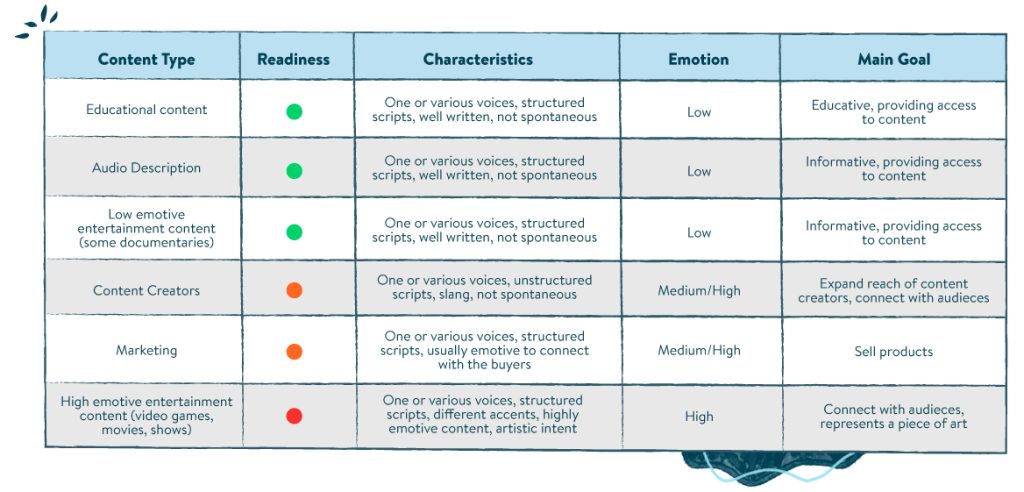
Table comparing different content types by readiness, characteristics, emotion level, and main goal. It includes six categories: educational content, audio description, low-emotive entertainment (documentaries), content creators, marketing, and high-emotive entertainment (video games, movies, shows).

When Is AI Dubbing the Right Fit? 

The table below offers a more-detailed breakdown of the ways in which AI dubbing can be a smart choice for certain types of content, particularly where production budgets are limited or speed is crucial. Use cases range from educational content and audio descriptions to lower-emotion entertainment, like documentaries. Content creators and marketers are also turning to AI dubbing to expand their reach—especially with platforms like YouTube integrating autodub features. 

But as the table also indicates, there can be limits to AI’s efficacy with content consumers. For emotionally charged productions like films, TV shows, or video games, for example, audiences expect nuance. This is where AI still struggles—and where human-generated post-editing must bridge the gap. 

Enter the Scene: The Role of Post-editing 

Post-editing plays a pivotal role in refining AI-generated dubbing to ensure it resonates with audiences and meets production standards. Beyond technical edits, post-editing also involves prooflistening—a final review that focuses on the listener’s experience. This step helps detect subtle inconsistencies or audio distractions that may go unnoticed in the editing process. 

To deliver high-quality results, post-editors must bear in mind: 

  • Regional Accents and Voice Consistency, which ensure cultural authenticity and coherence throughout the audio, and are especially important when dubbing for specific markets or across multiple episodes or segments. 
  • Speech Rate and Pronunciation, which improve clarity and flow by adjusting unnatural pacing or correcting mispronunciations. These are the sort of fixes that help the audience stay effortlessly engaged. 
  • Emotional Accuracy, which ensures the tone reflects the original performance. Whether the source content was exciting or languid, comical or sincere, the dubbed version must feel genuine and fully aligned with the original material’s intent. 
  • Lip-Sync Matching. This component of post-editing oversight, which is essential for visual content, ensures that spoken words align with on-screen lip movements. It serves to safeguard audience immersion and maintain professionalism in video formats. 
  • Client-Specific Audio Specs. These considerations cover everything from volume levels to file formatting. They ensure that the audio is ready for final delivery and integration with other production elements. 

Each of these post-editing considerations contributes to a seamless viewer experience—and it’s the human attention to these very human details that sets the final product apart. 

Conclusion 

AI dubbing is evolving fast, bringing greater access to localized voiceover than ever before. For global organizations and creators with growing content demands, it’s a powerful tool that unlocks speed and scale. But even as the technology improves, human involvement in the dubbing process remains essential. That’s specially true when the goal isn’t just about being understood, but about being truly heard—in the right voice, at the right time, by the right audience. 

Ensuring Quality in MTPE The Role of ISO 18587 - Portada
13/05/2025

Ensuring Quality in MTPE: The Role of ISO 18587

As global content demands continue to grow, Machine Translation (MT) has become a complementary tool in the language industry. Its speed and cost efficiency make it an attractive solution for companies looking to scale their multilingual communication. However, while MT technology has come a long way, it isn’t without its limitations—especially when it comes to nuance, cultural sensitivity, and industry-specific language.  

This is where human expertise enters the equation through Post-Editing (PE), creating a powerful synergy known as Machine Translation Post-Editing (MTPE). Let’s dive into why ISO 18587 plays such an important role in MTPE. 

The Role of ISO Standards in MTPE 

Post-editing enhances MT output by addressing the gaps that machines alone can’t close. By refining grammar, improving style, and ensuring the message resonates with local audiences, PE ensures that translations are not only technically correct but also culturally and contextually accurate. The result is content that sounds natural, is consistent in terminology, and meets professional standards—something that’s increasingly essential in today’s competitive global marketplace. 

To ensure consistency and quality in MTPE, industry standards play a vital role. One key benchmark is ISO 18587, a standard specifically developed for the post-editing of machine-translated content. Rather than focusing on strict compliance, ISO 18587 provides a framework for what high-quality post-editing should look like. It defines the competencies required of post-editors, outlines best practices for workflows, and sets clear expectations for quality and accuracy. For companies, adopting processes aligned with this standard helps streamline multilingual content creation while maintaining high standards of clarity and reliability. 

Why Post-Editing is Essential for Quality 

Why is post-editing necessary, even with increasingly sophisticated MT engines? Despite advances in AI, raw MT output often struggles with: 

  • Linguistic accuracy: Errors in grammar, syntax, and sentence structure. 
  • Cultural and contextual relevance: Lack of adaptation to local customs, tone, or idiomatic expressions. 
  • Style and readability: Robotic or awkward phrasing that diminishes the content’s impact

Post-editors address these shortcomings, bringing human judgment and linguistic nuance into the process. Their role is not just corrective—it’s transformative, shaping MT output into polished, publication-ready content. 

Best Practices for High-Quality Post-Editing 

Achieving high-quality MTPE also means applying best practices across projects. This includes: 

  • Full post-editing vs. light post-editing: Choosing the appropriate depth of editing based on content use. 
  • Linguistic and cultural adaptation: Refining messages to align with audience expectations and local context. 
  • Quality assurance (QA) measures: Incorporating review cycles, style guides, and reference materials to ensure professional standards are met. 

The Takeaway 

In short, MT is a powerful asset, but its full potential is realized only when paired with expert human post-editing. For companies looking to produce accurate, localized, and brand-consistent content, investing in professional MTPE is essential. As an ISO 18587-certified company, at Terra, we understand the value of combining technology with linguistic expertise. Partnering with a language service provider that follows ISO-based processes guarantees high-quality outcomes for diverse global audiences. 

An Insider’s Guide to Solutions Architects Balancing Innovation and Ethics
01/04/2025

The Role of Solutions Architects in Ethical Innovation

The localization industry has long relied on traditional methodologies to deliver first-rate translation work. But as technology continues to reshape the ways in which businesses communicate across borders, many translators are taking enthusiastic advantage of new and evolving tools to streamline their workflows and increase efficiency.  

To employ innovations like artificial intelligence (AI) and machine translation (MT) effectively and responsibly, localization experts must seamlessly integrate them into their processes while still ensuring that human expertise is driving the quality of the project.  

Few in the industry are better equipped to take on this challenge than a solutions architect (SA). Among their many responsibilities, which we outlined in an earlier post, solutions architects remain ever-mindful that any technology they use to augment any localization project has to complement human expertise—and not replace it.  

Let’s explore more about how an SA works to strike this essential balance between innovation and ethical localization

Ensuring Technology’s Positive Impact on Localization

An Insider’s Guide to Solutions Architects Balancing Innovation and Ethics - Sara Rodríguez

Localization technology has the enormous potential to transform workflows on a broad scale. Solutions like AI-powered translation systems can reduce turnaround times and ingest large volumes of content, while automation can simplify repetitive tasks. Such upsides are undeniable, but even so, these tools can present challenges. For example, human overreliance on technology during the localization process runs the risk of losing cultural nuance, and lack of human oversight can lead to biased or inaccurate translations.  

Solutions architects circumvent these pitfalls by crafting workflows that incorporate technological innovation to enhance human proficiency. “The key to using AI and MT is balance,” explains Sara Rodríguez, a solutions architect at Terra. “We integrate these tools into workflows to expedite processes, but we always require human oversight to maintain the highest level of quality control.” 

For instance, MT has the capability to generate initial drafts of translations for high-volume content—of, say, a technical manual. A solutions architect will ensure that the MT was carefully and securely trained on industry-specific glossaries and quality standards so that the technology’s output is as cohesive and informed as possible. However, the SA will also ensure that linguists then join the workflow to further refine the MT’s draft for even stronger accuracy and cultural relevance.  

Similarly, a solutions architect might design a workflow in which AI accelerates various repetitive tasks, which frees professionals to focus on facets of localization that require creativity and cultural expertise

The Vital Role of Human Oversight

In the end, it is that very human creativity which is so essential to preserve, and which remains an irreplaceable factor in successful localization. Technology alone cannot deliver it. Human translators bring cultural sensitivity, context, and an understanding of idiomatic expressions to their work in ways that AI cannot replicate.  

At Terra, solutions architects bear this in mind as they ensure that human input and checkpoints are prioritized and utilized in every workflow. In addition, our SAs remain vigilant for any project-related ethical considerations that must be made for people who may be affected by the technologies in use. 

“We think a lot about the EU’s General Data Protection Regulation,” says Sara. “The right of end users to not be subjected to a decision based solely on automated processing should be enforced.” 

Conclusion

As technology continues to shape the localization industry, the role of SAs becomes more critical than ever. By leveraging AI and MT responsibly while safeguarding cultural integrity, solutions architects build trust and deliver meaningful, authentic global communication. Their efforts not only ensure successful localization, but also reinforce the vital human connection that lies at the heart of every project. 

Accessibility in User Experiences (UX) in the Healthcare Industry
26/03/2025

Accessibility in User Experiences (UX) in the Healthcare Industry

The growing importance of accessibility in healthcare user experiences (UX) cannot be overstated. According to the World Health Organization (WHO), over 1 billion people worldwide live with some form of disability. Many patients also struggle with limited health literacy or language barriers when navigating healthcare platforms such as patient portals, scheduling apps, and telemedicine services. Without inclusive UX design, these individuals face significant obstacles in accessing critical health services.  

By prioritizing accessibility, healthcare providers can ensure equitable care for all patients, reducing disparities and improving overall health outcomes. 

UX Accessibility and Its Importance in Healthcare 

Accessibility in UX refers to designing platforms, applications, and interfaces that can be easily used by everyone, regardless of their abilities or limitations. In the healthcare sector, where clear communication and intuitive navigation can be the difference between effective care and patient confusion, accessible design is crucial. Healthcare platforms must accommodate individuals with visual, auditory, motor, and cognitive impairments while also considering language and literacy challenges.  

The Benefits of Accessible and Tailored UX in Healthcare 

Accessible UX in healthcare benefits all stakeholders by bridging communication gaps and promoting inclusivity. Some of the key advantages include: 

  • Patient empowerment. Well-designed, accessible platforms enable patients to take control of their health. Features such as clear navigation, voice-assisted options, and simplified language help individuals schedule appointments, access medical records, and understand treatment plans with ease. 
  • Broader reach. An inclusive design allows healthcare organizations to serve a wider patient base, including those with disabilities and language barriers. By implementing accessibility features such as screen reader compatibility, multilingual support, and high-contrast visuals, providers can cater to diverse populations and ensure no one is left behind. 
  • Trust and engagement. When patients can easily access and understand healthcare platforms, they are more likely to trust and engage with healthcare providers. A seamless user experience fosters stronger patient-provider relationships, encouraging continued use of digital health tools and services.  

The Consequences of Poor UX Design 

Neglecting accessibility in healthcare UX design can result in serious consequences, including: 

  • Inefficiencies for healthcare professionals. Poorly designed platforms hinder healthcare professionals (HCPs) from efficiently accessing critical patient data, potentially delaying care and increasing the risk of errors. 
  • Erosion of trust and increased costs. When patients and providers struggle with usability, it reduces trust in digital healthcare solutions, discourages adoption, and leads to higher operational costs due to increased support requests and inefficiencies. 

The Role of Linguistic Services in Improving User Experience 

Language plays a crucial role in creating inclusive and effective user experiences. Linguistic services enhance healthcare UX by addressing key areas: 

  • Simplified communication. Translating complex medical jargon into plain, everyday language enhances understanding, particularly for patients with limited health literacy. 
  • Assistive compatibility. Ensuring text and audio content are accessible via screen readers and other assistive technologies broadens usability. 
  • Consistency across channels. Harmonizing tone, terminology, and formatting across apps, websites, and printed materials enhances the overall user journey, reducing confusion and improving accessibility. 

Conclusion 

Accessibility in healthcare UX is vital for ensuring equitable and effective patient care. By prioritizing inclusive design, healthcare organizations can empower patients, improve engagement, and enhance the efficiency of healthcare professionals.  

As digital healthcare continues to evolve, providers must commit to creating user-friendly, accessible experiences that cater to all individuals, ultimately leading to better health outcomes and a more inclusive healthcare system. 

An Insider’s Guide to Solutions Architects: The Key to Long-Term Client Success
19/03/2025

Insights from Solutions Architects to Achieve Long-Term Client Success

Photo of Marina Ilari, CEO of Terra.

Localization projects are intricate in that they require a blend of linguistic expertise, technical know-how, and strategic vision. At the heart of any successful localization effort lies a pivotal role: the solutions architect (SA). An SA’s involvement goes far beyond initial setups, as Terra CEO Marina Ilari explains. “SAs play a very important role in building and maintaining long-term client relationships. They act as proactive, trusted partners who are committed our clients’ success.”  

Let’s explore the multifaceted responsibilities of solutions architects and their impact on long-term partnerships.  

Building a Foundation of Trust 

Photo of Sara Rodríguez, a solutions architect at Terra.

Throughout the localization process, trust between a client and its translation team is the cornerstone of a successful partnership. Projects often involve sensitive data and high-stakes outcomes, making it essential for both parties to be willing to build strong relationships from the start. SAs are instrumental in fostering this trust by prioritizing open communication and recognizing each client’s unique needs. 

“Genuine relationships with clients rest on trust and proactive conversations,” says Sara Rodríguez, a solutions architect at Terra. “An SA ensures that clients feel supported from the first day by taking the time to understand their concerns, aspirations, and preferences.” This personalized approach lays the groundwork for collaboration and ensures that clients feel confident throughout the process.  

Tailored Solutions for Every Challenge 

Localization isn’t a one-size-fits-all process. Every client has distinct goals and challenges, and it’s the job of a solutions architect to design workflows that address these nuances. From Translation Management Systems (TMS) to automation tools, SAs leverage a range of technologies to create scalable solutions. 

“We develop strategies to address bottlenecks in workflows, for example, or we’ll integrate technology like CAT tools,” says Sara. “I’ll often be working to streamline processes to meet a client’s business goals like market expansion or regulatory compliance,” she adds. 

By tailoring workflows to meet specific requirements, SAs ensure that translation projects achieve their immediate objectives, while also remaining flexible for any adjustments clients need to make in the future. For instance, by implementing secure TMS systems with role-based access and real-time quality checks, Terra’s SAs have helped clients manage high-volume, time-sensitive projects with confidence in the moment, while ensuring those same systems and checks will remain workable for clients down the line.  

Supporting Growth Through Continuous Optimization 

Delivering results is only the beginning of a solutions architect’s work. As they stay actively involved throughout the lifetime of a project, they provide support and refine processes along the way. This iterative approach not only boosts operational efficiency but also ensures adaptability in industries like gaming or healthcare, where localization needs can evolve rapidly. 

Soledad Coronel, one of our solutions architects, explains, “The goal is to apply industry best practices in design and development, which include design patterns, scalable architecture, and quality standards.” An SA’s commitment keeps workflows robust and adaptable so clients continue to meet their objectives. 

One notable example of effective continuous optimization that we executed at Terra involved a high-volume video game task that required localization into 15 languages under tight deadlines. The SA in charge developed a workflow that featured contextualization tools and automated checks throughout the life of the project, which resulted in our delivering high-quality translations on time.    

Language, Technology, and the Irreplaceable Human Touch 

In today’s localization landscape, technology is indispensable. But even with advances in AI and automation, the human element remains essential to the localization process. SAs know firsthand the subtleties of what human translators bring to the table, and in an increasingly tech-driven world, SAs reinforce the importance of the human touch by leveraging it in the right places. 

Photo of Soledad Coronel, one of our solutions architects at Terra.

“Translators and linguists bring cultural nuances and idiomatic accuracy that machines can’t replicate,” says Soledad. “Our role requires us to understand that gap between human linguistic expertise and cutting-edge technical solutions, so we can effectively implement the strengths of both.”  

From automating repetitive tasks to managing the human element of complex workflows, SAs bring clarity and optimal efficiency to every project, all while staying true to the client’s vision.  

“Our work really demands a unique blend of cultural sensitivity, technical expertise, and strategic thinking,” Soledad adds. “And then, beyond understanding those tools, it’s about aligning those them with client objectives to deliver impactful results.” 

Conclusion 

The role of a solutions architect is pivotal to achieving successful and long-term client relationships in localization. By combining technical knowledge, cultural insight, and a client-first approach, SAs help businesses navigate the complexities of global markets with confidence.   

Their work not only addresses immediate project needs, but also lays the foundation for sustainable growth and continued success. For any organization aiming to excel in localization, partnering with a skilled solutions architect is a step toward achieving impactful and lasting results.

AI Ethics Essentials Key Principles for Responsible Implementation
04/03/2025

AI Ethics Essentials: Key Principles for Responsible Implementation

As artificial intelligence (AI) tools become a vital part of modern business, it’s easy to view them as a silver bullet for company-wide efficiency, cost savings, and innovation. But, as the saying goes, with great power comes great responsibility. No matter how a company employs AI, using it ethically should not be a choice, but an essential practice to build trust, ensure fairness, and protect the people who use these tools or are impacted by them. 

Following sound ethical principles for AI, such as these laid out by the European Union, can make these sorts of positive differences right from the start. From there, organizations should take the time to periodically reevaluate their AI tools to ensure they continue to align with their values and safeguard their users. Here, we’ll cover seven fundamental concepts that every company should consider before implementing AI solutions. 

1. Transparency in The Usage of AI Solutions 

Transparency is the foundation of ethical AI. When team members or clients interact with AI solutions, they should be able to easily follow how the tool reaches its conclusions or outputs. It is recommended that all processes involving the use of AI be identifiable and documented for future analyses and management. 

2. Support for Human Agency 

AI should empower, not replace, human decision-makers. Keeping human power at the fore ensures that these tools act as partners to human expertise, rather than substitutes. AI-driven systems can offer recommendations and insights, but as the European Union’s AI guidelines note, “The right of end users not to be subject to a decision based solely on automated processing should be enforced.” Following this approach ensures that technology enhances, rather than diminishes, the human touch on the job at hand. 

3. Reliability and Safety 

Reliability and safety are essential pillars of ethical AI. Before implementation, it is crucial to verify that AI works as intended and performs consistently over time. Reliable usage of AI technology is especially important in areas with high-stakes outcomes like healthcare or pharmaceuticals, in which even small errors can have significant consequences. 

4. Diversity, Non-discrimination & Fairness 

An ethical approach to AI usage respects diversity and prioritizes inclusion, which means it must be tested carefully for unintended biases and further evaluated to ensure it serves a wide range of users equitably. While AI systems aren’t inherently designed with inclusivity in mind, using them responsibly can support diverse populations and reinforce a company’s commitment to fairness. The goal should be to create or leverage tools that acknowledge and adapt to the unique backgrounds of all users.  

5. Privacy Protection and Data Security 

Data security is paramount in ethical AI use, as the technology relies on vast amounts of information. For clients, prioritizing their privacy means ensuring their sensitive or proprietary information is securely managed across platforms and departments. To protect client data, businesses should choose AI providers with robust security measures and transparent data practices that safeguard information at every stage. 

6. Societal & Environmental Wellbeing 

In an age of climate awareness, it is also essential to consider AI’s environmental footprint. AI can be energy-intensive, so opting for energy-efficient solutions internally or partnering with external providers with green practices is important. Environmentally responsible AI solutions are those that help solve business challenges in a sustainable way that respects our planet’s resources.  

7. Accountability 

Accountability ensures that companies remain responsible for their AI tools’ actions. Having clear processes to audit and evaluate AI decisions is essential. This way, businesses can address issues, learn from them, and continue to improve. Accountability in AI use demonstrates to users and stakeholders alike that you take responsibility for your actions. 

A Final Thought for Businesses 

Ethical AI implementation is not just about staying ahead in innovation; it’s about doing so in a way that upholds trust, transparency, and inclusivity. By following these principles, you will be well-positioned to implement AI responsibly, thus making a positive impact on both your clients and society as a whole. For industries like translation, healthcare or pharmaceuticals in which data security and cultural sensitivity are paramount, adhering to ethical AI principles helps deliver not only reliable results, but also peace of mind.