
Section 508 Compliance Creating Accessible Documents
25/02/2025

Section 508 Compliance: Creating Accessible Documents

Digital accessibility is more than a legal obligation—it’s a moral commitment to inclusivity in the digital age. Section 508 compliance ensures that digital documents are accessible to individuals with disabilities, removing barriers and promoting equality. Organizations, especially those within or partnering with the government, must adhere to these standards to avoid legal risks while also expanding their reach and building trust by demonstrating a commitment to diversity and inclusion. 

Let’s take a closer look at the growing importance of accessibility and how to tackle this mission in your organization.  

Features of Accessible Documents: What to Consider 

Ensuring document accessibility requires integrating specific features across various formats, including standard documents and specialized materials like e-learning courses.  

These are essential elements to consider: 

  • Document properties: Assign meaningful titles, enable bookmarks for easy navigation, and set the correct language to enhance compatibility with screen readers. 
  • Font and contrast: Use readable fonts with high contrast between text and background. This principle applies to all visual elements, including icons and graphics. Increasing font size can further improve visibility and user experience. 
  • Usage of color: Avoid relying solely on color to convey meaning. For example, instead of using only red to indicate an error, incorporate text or symbols for clarity. Ensure color combinations are accessible to individuals with color blindness by avoiding red-green pairings. 
  • Reading order: Structure content logically, numbering elements appropriately while excluding decorative items from the reading flow. 
  • In-text modifications: Avoid splitting words with hyphens at line breaks and maintain consistent spacing between lines and paragraphs for readability. 
  • Alt text for visuals: Provide concise, descriptive alt text for images and logically organize hyperlinks to prevent confusion. 
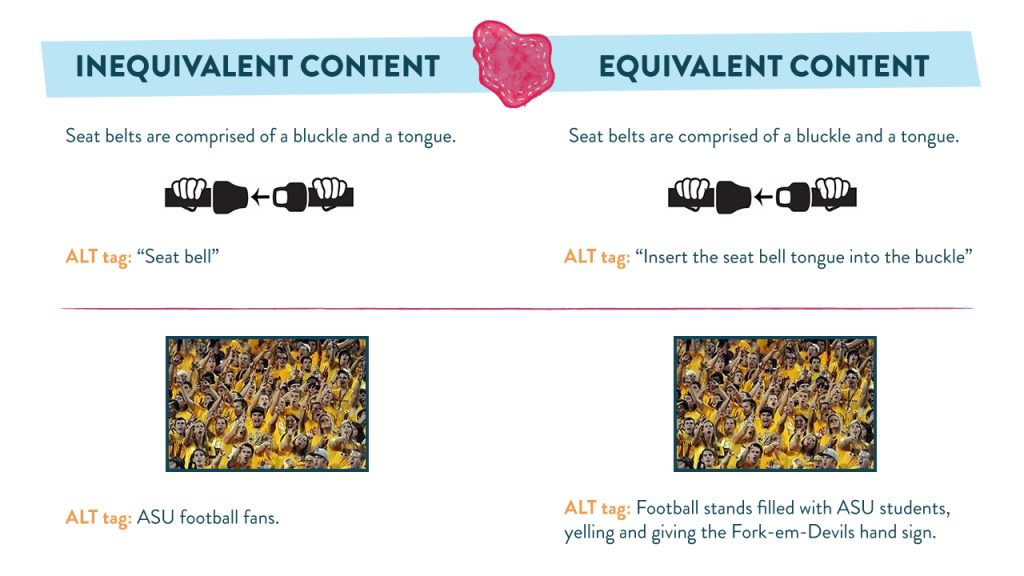
Examples of ALT text for visuals 1
Arizona State University
  • Tables: Include summaries and properly label headers to facilitate navigation for users relying on assistive technology. 
  • Multimedia content: Provide captions and audio description for videos, transcriptions for audio content, and alternative text for visual elements to ensure accessibility across all media formats. 
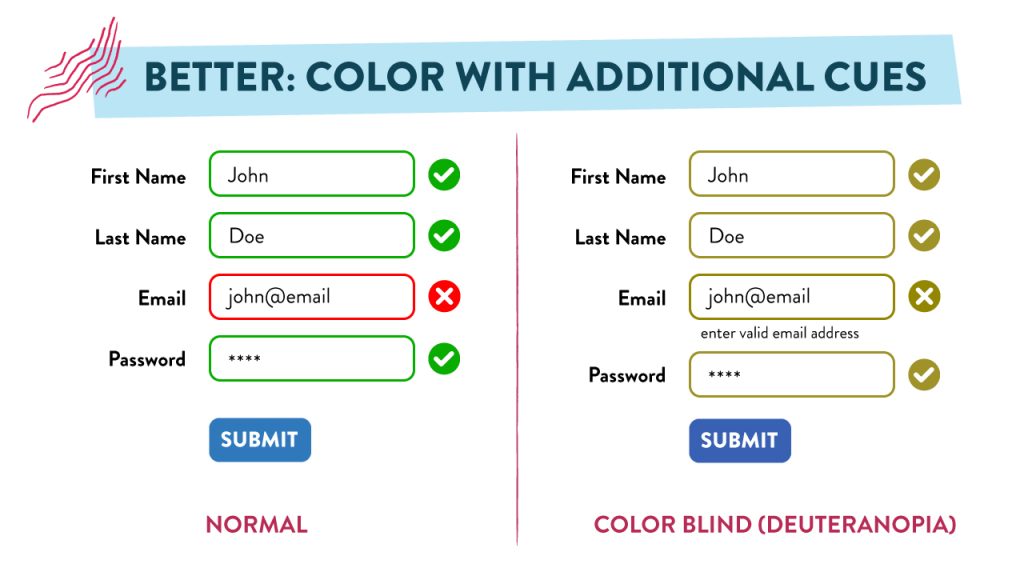
Example of form with colors with additional clues (deuteranopia).
Graphic from Crux Collaborative

While these features are essential for creating accessible documents, not all will apply to your future projects. Collaboration with an accessibility specialist helps balance mandatory requirements with optional features tailored to specific projects. 

What to Expect When Requesting Accessible and Localized Documents 

Whether a client requires accessibility features alone or a combination of accessibility and localization, partnering with a knowledgeable Language Service Provider (LSP) ensures a smooth workflow and compliance with inclusivity standards.  

Here’s what to expect: 

  • Initial consultation and planning: The process begins with a collaborative discussion where the LSP identifies required accessibility features and recommends additional enhancements based on the document’s purpose and audience. This step aligns expectations, budget, and regulatory standards. 
  • Localization with accessibility features maintained: If localization is needed, the LSP ensures that content is culturally and linguistically adapted while maintaining accessibility features. Translated alt text, captions, and accessible navigation remain intact for an inclusive experience across different languages and regions. 
  • Final review and quality assurance: Desktop Publishing (DTP) experts conduct a comprehensive review to ensure quality across the board. Accessibility, formatting, and localization elements all should align professionally. Any discrepancies in design, structure, or compliance are addressed to meet the highest standards. 

The Takeaway 

Accessibility is not just about compliance—it is about fostering an inclusive digital world. By partnering with an experienced LSP, organizations can ensure their documents are not only accessible and compliant but also effectively adapted for diverse audiences. Investing in accessibility today helps create digital environments that empower all users and cultivate a culture of inclusion for the future.


Data Protection Do you Need a US-Based Translation Team - Portada
10/06/2019

Data Protection: Do you Need a US-Based Translation Team?

The internet has opened up a world of possibilities. These days, it’s not uncommon to work with colleagues from every corner of the globe. This global access allows companies to find the best talent, services, and contracts for their business. But there are times when domestic work is an absolute necessity. Some companies and organizations may require working with a US-based translation team in order to prioritize security, protect data, or adhere to strict regulations. Why is that exactly?

Why Work with a US-Based Translation Team?

A company or organization might need to work with a US-based translation team for many reasons. A few scenarios can include:

  • If they need a notarized translation within the US
  • If they have to work with translators who have undergone a background check
  • If any files and information must remain in US territory
  • If specific security measures must be in place

As a safety precaution, some clients that work with sensitive information may need their documents to stay physically within the United States. Meaning, the linguists working on the projects need to be US-based, as do the Project Managers. Even the servers where the files are stored, or are used for transfers, may need to remain in the United States.

Who Needs a US-Based Translation Team

The needs for a US-based translation team can vary, but some of the clients that may require such services include:

  • Government agencies: Local, state, and federal agencies have varying regulations they need to adhere to. The United States government has statutes that all translation services will be performed within the boundaries of the United States. The inability to perform services in the United States can be grounds for disqualifying a contract.
  • The military: As a branch of the United States government, they are also required to meet strict standards regarding translation services.
  • Healthcare providers: Those in the healthcare space, may also need translators and Project Managers to undergo a HIPPA training. The Health Insurance Portability and Accountability Act of 1996 (HIPAA) aims to protect the confidentiality of the protected health information (PHI) that is translated. The US Department of Health has called out their expectations regarding security on their website.
  • Financial institutions: There is a large amount of sensitive data handled by financial institutions regarding business, employees, and customers that is protected by industry and government regulations. If a financial institution works with healthcare companies, HIPAA guidelines may apply.
  • Companies: Any companies involved in the research, development, sale or maintenance of goods regulated by the US government, such as pharmaceuticals, may be required to use US-based translation services.
  • Exporters of defense and military-related technologies: Under International Traffic in Arms Regulations (ITAR) there are mandatory compliance rules that must be followed regarding translation services for the Defense Department and all of its suppliers.

What We Can Offer

Terra has a robust team of international team members, including US-based translators and Project Managers. As business associates of covered entities, we understand the importance of being HIPAA compliant and our team has undergone HIPAA training with certification.

It is worth noting that HIPAA Rules do not include specific requirements regarding the protection of electronic protected health information (ePHI) processed or stored by a cloud service provider (CSP) or business associates outside of the United States. However, the Office for Civil Rights (OCR) warns that risks related to the ePHI may vary based on location. For example, risks can increase considerably when outsourcing storage or other services for ePHI overseas due to the enforceability of privacy and security protections over the data.

Alongside offering US-based translation services, our project management process meets and exceeds the most demanding requirements, including workflow, timelines, roles, responsibilities, and deliverables.